TL;DR: If you know what to do but haven’t done it, you’re not lazy — lazy people don’t launch businesses, sign up for webinars, or mentally write email sequences on the dog walk. What’s actually missing is one piece of Action Architecture: Spark (your desire, belief, identity), Strategy (goal broken into milestones and actions), and Setup (an environment built to survive your worst possible week, not your best one). Willpower alone runs out, so missing any one of the three leaves you stuck in a specific way — running on willpower alone, spinning without direction, or grinding through someone else’s plan. All three together, planned intentionally, is what produces consistent action.
Why am I so lazy? I know what to do — the podcast, the launch, the lead magnet. I’ve been starting it for weeks, maybe even months, and I’ve still not done it. Why is this happening?
I want to be clear: if you’re in this situation, you are not lazy. Lazy people don’t launch businesses. They don’t sign up for all the webinars and courses. They don’t jump on networking calls, redesign their website at eight o’clock at night, or mentally write their welcome email sequence on the dog walk.
So what is actually going on?
Introducing Action Architecture
I want to introduce you to my framework, Action Architecture — the conditions you need in order to do the work and make action inevitable.
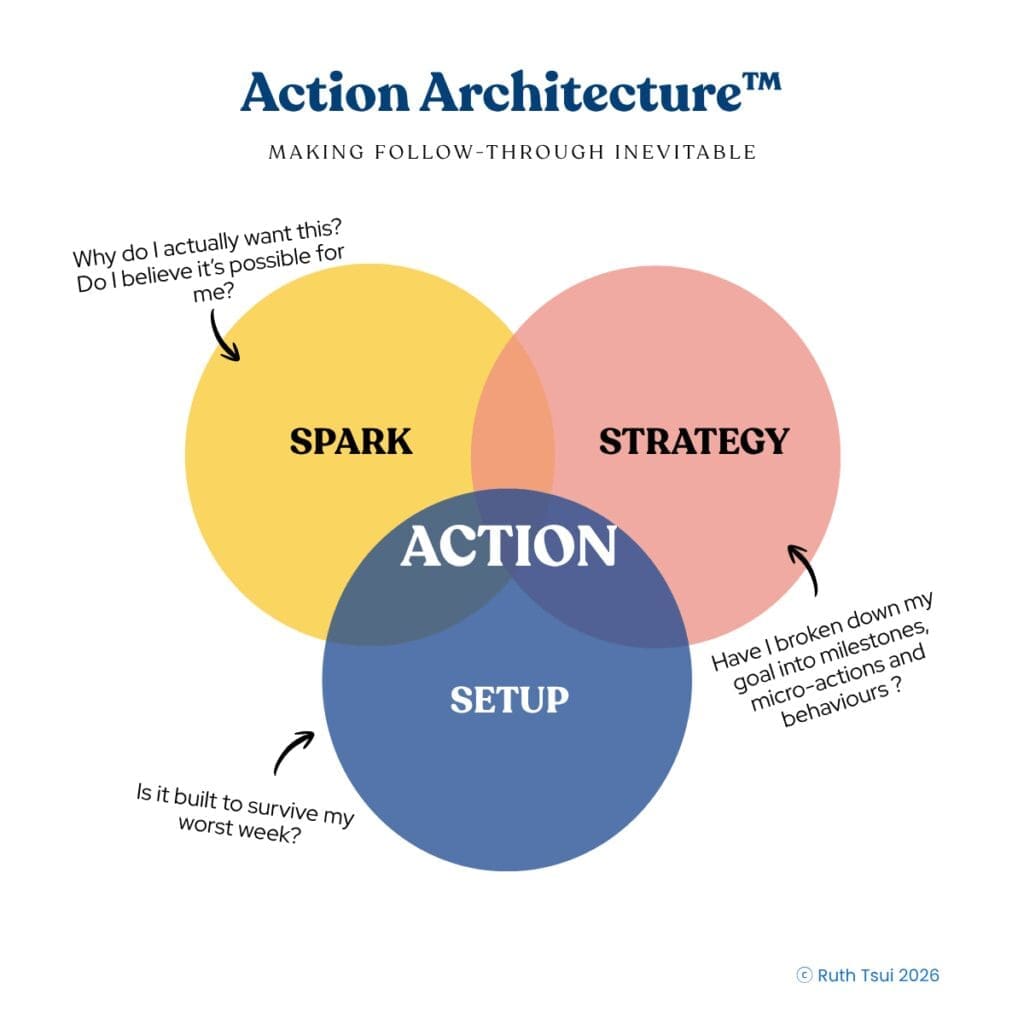
Spark. Why do I actually want this? Do I believe it’s possible for me? This is about your desire, your belief, and your identity.
Strategy. Have I broken down my goal into milestones, micro actions, and behaviors? Change and progress come from doing something differently. Have I actually taken my strategy and turned it into an actionable plan — milestones and actions?
Setup. The environment we’re setting up for ourselves. The question we really want to answer is: are the circumstances we’ve created built to survive our worst possible week? Think about the weeks with zero energy. The weeks where a kid’s off sick at home for three days. Those weeks really test us — but they’re also the reality of running a business and living life at the same time.
There’s no such thing as a perfect week, and waiting for the perfect week to execute means you’ll be waiting forever. There’s always going to be another school holiday. There’s always going to be something that throws a spanner in the works. So we need our setup too — how we’re keeping ourselves accountable, how we’re celebrating our wins, how we’re building habits that let us maintain progress even when things get difficult. Is it built to survive the worst week?
When the spark, strategy, and setup all intersect, that’s where we get focused execution — the action that actually gets us to launch the lead magnet, create the course, write the book.
We need all three together at the same time, happening together, planned intentionally, in order to move us to consistent action. And when I say consistent action, I don’t mean the same output every single day. There will be days where you can only do the bare minimum — but it’s knowing what that bare minimum is, and then taking advantage of the days where you’ve got loads of energy to get the thing done.
What Happens When One Piece Is Missing
Spark + Strategy, no Setup: willpower alone is running the show. The problem with relying on willpower alone is that it’s finite. It’s an exhaustible daily shot you get in the morning, and the more decisions you have to make, the more things get thrown your way, the more you’re having to consciously think about things — the faster that reserve depletes until the next day. If you’re not setting up your environment for success — habits, accountability, support, progress tracking — when things get hard, you will quit, because your willpower wanes every single day.
I have an amazing morning routine, lots of habits built in. One thing I’m currently trying to introduce is cod liver oil tablets. Seems small and trivial — but I can’t have it in the morning, it needs to be with lunch, because I need to eat certain things for it to be absorbed effectively. By the time lunchtime comes, I’ve forgotten that taking it was something I needed to do. Even though I’m really good at building habits in the morning, the cod liver oil tablets are proving much harder, because by lunchtime my willpower reserves have already waned.
Spark + Setup, no Strategy: running around like a headless chicken. We’re trying to do everything, but not really achieving anything. This can actually lead to burnout — so focused on juggling all the plates and keeping everything spinning that nothing gets completed, and we feel exhausted. It’s active output with no real results.
Strategy + Setup, no Spark: you’re “should”ing yourself. You’re following somebody else’s roadmap, somebody else’s blueprint. It doesn’t feel like yours. The desire isn’t there, the belief isn’t there, and fundamentally, it’s just a drag. It feels like a grind. Even though you know it’s the sensible thing to do, it’s really not what you actually want to do.
Building the Same Consistency You Already Have Elsewhere
There are things in your life you’re ruthlessly consistent with. Serving your clients to the best of your ability. Picking your kids up from the school run — I don’t think you’ve ever left them at school and forgotten about them. Going for a daily walk, whatever it might be. There are things you do on a daily basis that you never stop doing, whether it’s a good day or a bad day.
We need that same kind of inbuilt support structure — this architecture — around building momentum and progress in our business, the way we have it for these other things in life. If we can be consistent in doing the school run, we can also be consistent in whatever we want to do in our business — launching that podcast, whatever it might be. So what we need to focus on is how we build that architecture around our business, around our work.
Finding Your Gap
There are four implementation patterns you might be stuck in right now. Take the quiz to find out what your implementation pattern is, where you’re getting stuck, and which of the spark, strategy, or setup gaps you might have. There are four archetypes, but only three underlying pieces — so there’s crossover between them. Take the quiz, find out which implementation pattern you’re running, and what your pathway out is.
Which piece is missing for you right now — spark, strategy, or setup?


click to Read & Leave a comment
Click to close comments
Comments